
UPSA returns to Balai Isabel Church Ruins
By Nicole Grace H. Casing
UPSA Graduate Student
The “Pantropocene: Finding a pre-industrial, pan-tropical ‘Anthropocene’” is an ERC-funded project focused on studying pre-colonial and colonial period land use across the bounds of the former Spanish Empire, particularly in Philippine regions (Mabanag et al., 2024; Max Planck Institute of Geoanthropology, n.d.). One of the sites under study is the Balai Isabel Church Ruins in Talisay, Batangas (site code: IV-2011-P). In 2011, the National Museum of the Philippines conducted the first archaeological excavation at the Balai Isabel Church Ruins site, where human remains were recovered and a volcanic tuff structure was recorded (Vitales et al. 2011). The University of the Philippines School of Archaeology (UPSA) team re-excavated the site in 2023 under the Pantropocene project, where they exposed four pairs of articulated human lower limb and foot bones extending into the south wall of Trench F, one of the three trenches opened during that excavation season (Barretto-Tesoro et al., 2023). Due to the lack of time, the foot bones and the lower limb bones were left to be retrieved in the next excavation season.
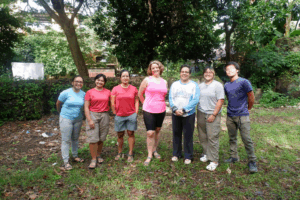
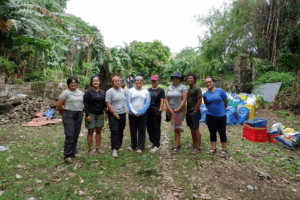
The UPSA team, composed of Dr. Grace Barretto-Tesoro, Alyssandra Marie Lopez, Joan Quincy Lingao, Nicole Grace Casing, Marvin Dorosan, Raisa Perez, Dr. Kimberly Plomp, Andrea Dominique Cosalan, and Marie Louise Antoinette Sioco, returned to Balai Isabel Church Ruins site, Talisay, Batangas from October 21 to November 10, 2024 (Figures 1 and 2). This excavation aimed at retrieving the human skeletal remains exposed during the 2023 excavation in Trench F.
Upon arrival in Talisay, Batangas, we immediately settled down and made courtesy calls, and on our second day, we started the actual excavation. As the first human burial from the 2023 excavation was exposed, alerts were being received about Typhoon Kristine. Swift actions were taken to document and retrieve the human remains before Typhoon Kristine hit Batangas. Andrea Cosalan described the action we had done as similar to rescue archaeology. Almost a week was spent excavating under dark clouds, pouring rain, and a rising water table. Excavations were suspended for a few days due to the strong wind and heavy rains caused by the typhoon. When excavation resumed, more articulated human burials were exposed, extending into the south wall of the new trench. As more unexpectedly articulated and disturbed human remains were being unearthed, we were surprised by a pile of commingled remains in the middle of the trench.
As the youngest and most inexperienced member of the team, this excavation was a learning opportunity for me, but it also was one for all the team members. The excavation became a venue where we can clarify things we are unsure how to do without the feeling of being judged. As this 2024 excavation in Balai Isabel Church Ruins was my first fieldwork after the UPSA archaeological field school, I experienced firsthand how archaeological field methods vary depending on the field director, excavation site, and research questions, and how flexible field methods can be based on the circumstances on-site. Every archaeological excavation has its own flavor. The 2024 excavation in Balai Isabel Church Ruins is a good example of the truth that one can never be too prepared. The experience taught us to anticipate all the things that can happen in an excavation. And flexibility, adaptiveness, resourcefulness, and good teamwork make an archaeological excavation successful.
Although we could not retrieve all the human remains from the 2023 excavation, new lines of questions arose as new articulated and commingled human remains were exposed and recovered. Due to the time constraint, some human remains were left unexcavated during this 2024 excavation. I am excited for the new UPSA team that will be returning to the Balai Isabel Church Ruins and uncovering more of its history.
Works cited:
Barretto-Tesoro, G., Lingao, J.Q., Perez, R., Mariano, K., Mabanag, M., Robles, E.C. and Vitales, T.J. (2023). Archaeological excavation of the Club Balai Isabel Site, Talisay, Batangas.
Mabanag, M., Barretto-Tesoro, G., Vitales, T.J., Robles, E. and Roberts, P. (2024). Survey work in the Southern Tagalog region as part of the Pantropocene project. Testpit, 25, 15-21.
Max Planck Institute of Geoanthropology. (n.d.). “PANTROPOCENE – Finding a Pre-industrial, Pan-tropical ‘Anthropocene'”. https://www.shh.mpg.de/1489404/pantropocene-group