
Marvin Dorosan
Research Associate, PANTROPOCENE; Graduate Student, UP School of Archaeology
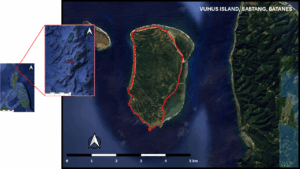
Vuhus Island is an uninhabited island to the west of Sabtang. It has an approximately 6.45 km² of land area with its shorelines surrounded by reefs (Figure 1). The island was initially described as a wide grassland. However, upon the visit of the team, the vegetation in the area was different. The majority of the island was covered with overgrown bushes of Pandanus sp., and other areas had bonsai-like trees. The inner portion of the island were covered with higher trees that are at least 50 years of age and some coconut trees. It is home to wild cows, which freely graze throughout the whole island. The ridge at the southwest of the island was the highest point, while the south portion of the island was a huge outcrop that was prone to rockslides and erosion. An area at the east of the island was designated as a contemporary settlement site for visitors and boatmen. The main mode of transportation on the island was walking and hiking. There were also portions where rock climbing was required in order to reach some sites of interest. The majority of the limestones on the island were sharp and were heavily eroded.
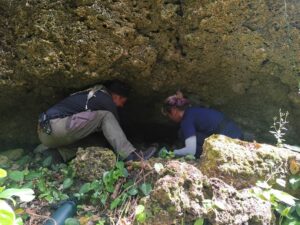
For the duration of the team’s stay on Vuhus Island from 16-23 April 2025, the team were able to identify new interesting sites and features while also being able to gather photogrammetry data. Guided by the locals who lived on Vuhus in the past, the team was able to reach previously recorded sites on the island: (1) the Chuhangin Idjang, (2) Paso Idjang, and (3) the Vula Habitation Site. Some walls in the Chuhangin Idjang were still intact, but we were unable to go to the site itself because it was dangerous. We found that the site was directly beside a steep cliff that was in danger of being naturally eroded. Just below the Chuhangin Idjang right beside the shoreline, a human burial was found by the team protruding from an outcrop. On the other hand, the Paso Idjang was located on an undulating terrain. At first, the site was hard to locate because there were no apparent features that could be found but upon further exploration of the southern area of the island, we found the site under heavy vegetation. There were still stone walls made of sharp limestones that were still intact. We also noticed some stones that were unusual to be found in the site. Several limestone rocks were also found to be scattered in the area. Just below the site was a depression that was hypothesized to be a riverbed in the past. On the other side of the “riverbed” was a wide flatland with limestone rocks scattered around. This area was thought to be another settlement in the area different from the Paso Idjang settlement. Lastly, the Vula Habitation Site was visited by the team, and we did not expect it to be so vast and complex. Several stone walls were still intact and were branching from one another. There were stones in some ends of these walls that looked like columns in the past. Furthermore, several new possible burial sites were found within and beyond the habitation site. Some of which were resembling boat-shaped markers and were beside each other. Finally, the team were also able to visit the northeast shoreline up until the north of the island. Here we found some disturbed human skeletal remains. This was after the local guide had mentioned that there were some intact burial jars seen on this part of the island in the past and now they were completely gone. Upon further investigation, we also found some large earthenware fragments on the outcrop of the shoreline.
Just like the previous fieldwork for this campaign, this fieldwork in Vuhus Island was not without challenges. One major challenge that the team encountered were those concerning logistics in the islands. Since it was an uninhabited island with no electricity or potable water, the team had to source food and a power station prior to going to the island. We needed to carefully plan the flight times and budget the battery power of the drone to complete the photogrammetry data of the island. Furthermore, there was no means to contact the other team members in the headquarters that was on the other island. It is as if the team was completely isolated away. The idea to stay on the island for three days was not in the original plan but we have decided that it would be more beneficial and more efficient to stay there because of the uncertainty of access to the island because of some restrictions (e.g., availability of boats, local guides, tides). The team needed to adapt to the unpredictable nature of the fieldwork.
Similar to the previous recommendations and suggestions from other fieldworks of this campaign, ample time to plan is ideal. However, since there were a lot of things that needed to change because of the circumstances, the ability of the team to adapt to these circumstances was always needed.